Thursday, April 24, 2025

GERMAN PHASE 1 INSTRUCTOR - DR. KENNETH HEGER

 From German Girls Genealogy (Teresa Steinkamp McMillin & Debra A. Hoffman):

In the last few posts, we talked about the new German research course that we (Debra A. Hoffman, PLCGS, and Teresa Steinkamp McMillin, CG) have been developing. “German Phase 1: Identify the Hometown” is scheduled for this coming Fall 2025. Registration will open May 17th https://slig.ugagenealogy.org/slig-fall-virtual/. 

We are excited to have Kenneth W. Heger, PhD, teaching with us in Phase 1. One of his many areas of expertise are American consulate records. This is an underutilized resource but can provide rich information. Dr. Heger will be teaching two sessions.


The first “Using State Department Despatches to Find Your Family's Hometown, 1800-1906,” 

covers how to find the death reports, marriage certificates, and estate case files that American consulates in Europe sent to the Department of State. It explains how to use those records to identify your family’s hometown in Europe.


His second session “Using Consular Records to Find Your European Family, 1800-1906” explains how American consulates maintained extensive files to do their work overseas. These include information the consulates did not regularly include in despatches to the Department of State. This presentation covers how to identify and access those files, and how to mine them to find information about European families, including relatives’ names and where the family lived.


Dr. Heger is a seasoned archivist and historian, whose career includes being the Director of the University of Maryland’s Archives and Digital Curation specialization in the College of Information Studies and a 32-year employee at the National Archives.  He publishes articles and makes presentations focused on using federal records to research your family’s history.  He is the president of the Mid-Atlantic Germanic Society, a regular instructor at the Genealogical Institute of Federal Records, a vice president of the International German Genealogy Partnership and has a Ph.D. in History.


Registration for 2025 SLIG Virtual courses opens on Saturday, May 17th. See https://academy.ugagenealogy.org/courses/german-phase-1-identify-the-german-hometown/ for more information. The details about the sessions, as well as pricing, are now available.

Thursday, April 17, 2025

German Phase 3: Research Abroad in Baden-Württemberg - SLIG

 From German Girls Genealogy (Teresa Steinkamp McMillin & Debra A. Hoffman):

In the blog posts of the past two weeks, we talked about the new German research course that we have been developing. “German Phase 1: Identify the Hometown” is scheduled for this coming Fall 2025. Registration will open May 17thhttps://slig.ugagenealogy.org/slig-fall-virtual/.  


“German Phase 2: Research the Hometown Online” is planned for late 2026. The first iteration of the third phase “German Phase 3: Research Abroad in Baden-Württemberg” is planned for late 2027. 


As with any research, not everything is online. Sometimes you need to visit archives to find what you need. This is exactly what “German Phase 3” addresses: going beyond church and online records. In our vision, there will be multiple Phase 3 courses, each dedicated to a different German state or historic region. I mentioned before that Germany was not a country until 1871. For that reason, the record keeping was different from one region to another. The archives are all different. You need to become proficient in researching your specific region. That is the idea behind Phase 3.


We conducted a survey of researchers to see what German areas they were most interested in. Baden-Württemberg was one of the top locations. This course will discuss how to prepare for research overseas. We will be covering sources that may only be accessed by going there. Other popular areas for Phase 3 courses include Rhineland-Palatinate and Hesse. We plan to continue repeating Phase 1 and Phase 2, as well. You can see we’re in this for the long-haul! 


We will keep you posted as the courses unfold. We’d love to hear your feedback, too!

Thursday, April 10, 2025

German Phase 2 Course - SLIG

From German Girls Genealogy (Teresa Steinkamp McMillin & Debra A. Hoffman):

In last week's blog post we talked about the new German research course that we (Debra A. Hoffman, PLCGS, and Teresa Steinkamp McMillin, CG) have been developing. “German Phase 1: Identify the Hometown.” is scheduled for this coming Fall 2025. Registration will open May 17th https://slig.ugagenealogy.org/cpage.php?pt=524.

As you might imagine, we have ideas for more than just one phase. Tentatively, “German Phase 2: Research the Hometown Online” will be taught in fall 2026. Once the exact location of a hometown is identified for a German immigrant, the search can begin for church records for that town. Church records are the primary source used to research a German ancestor. Before 1871, Germany was not a country and civil registration was not universally available. The one constant were the churches. They were the early record keepers. Often, but not always, church records are digitized and available online. This course teaches how to find and use those records.

Other records, too, are becoming available online. Some examples are emigration lists, newspapers, civil registration records and even consulate records. This course shows you how to find all available online records for your research.

Knowledge of old German handwriting becomes essential in this course. We will include an introduction to this concept. Beginning in Phase 1 and continuing in Phase 2, we will be giving you an arsenal of resources to learn this handwriting. As you work with the records in Phase 2 and with the resources we point you towards, you will become ever more comfortable with the handwriting.


Catch next week’s blog post where we’ll tell you our ideas for Phase 3. It just keeps getting better!


Saturday, April 5, 2025

German Phase 1 Course - SLIG

 From German Girls Genealogy (Teresa Steinkamp McMillin & Debra A. Hoffman):

German Phase I Course - SLIG

Debra A. Hoffman, PLCGS, and certified genealogist Teresa Steinkamp McMillin have partnered to create a series of German courses with the first one being offered through the Salt Lake Institute of Genealogy (SLIG) starting in October 2025. Phases 2 and 3 are tentatively scheduled for the fall of 2026 and 2027.


The set of three courses is designed
 to educate German genealogical researchers to locate the German hometown in Level 1,  research the town in  traditional online German sources in Level 2, and provide region-specific knowledge and sources in Level 3, so that successful onsite research can be conducted.  

As stated above, the objective of the first course, entitled German Phase 1: Identify the Hometown, is to locate the town of origin in Germany. In conducting research on German immigrants, it is not enough to know they came from Germany or even a specific German state. This course teaches students how to find the hometown by conducting thorough research using United States sources and utilizing appropriate methodology. The presentations are meant to provide a solid grounding in historical information on German settlement in the United States. Sources that typically provide the German town will be covered as well as the methodology to effectively use them. Students will have the opportunity to participate in a one-on-one consultation with a faculty member to discuss their research problem. The students will be working on their individual research project over the five weeks and will have time between sessions to put the new information into practice. 


Registration for 2025 SLIG Virtual courses opens on Saturday, May 17th. See https://slig.ugagenealogy.org/slig-fall-virtual/ for more information on the course and for details on how to register.

Thursday, March 27, 2025

 From German Girls Genealogy (Teresa Steinkamp McMillin & Debra A. Hoffman):

When researching in a specific area in Germany, it is important to connect with local researchers. They often have unique tools they use when deciphering old records from their area. As American researchers, we might not be aware of them.


We were recently visiting the area of Ellenfeld, Bärnau in the district Tirschenreuth in Bavaria. It is a small town just on the border of the Czech Republic. Our friend has ancestry here. She arranged for us to meet a researcher who helped her in the past. 


This researcher was very kind and invited us into her home. We were talking all about the area and its history. She mentioned a book by someone named Riepl. Our ears perked up because this was new information to us. It was a dictionary of historical terms specific to Bavaria and Austria. 


When researching older documents, you inevitably find archaic words not in a modern German dictionary. We are accustomed to using resources such as German-English Genealogical Dictionary by Ernest Thode or Grimm’s Wörterbuch. There are other general ones. These are not specific to one region in Germany. They can contain region-specific words, but not an exhaustive list. Other tools become necessary. A regional dictionary has a much better chance of helping. 


We now own this book! Always on the hunt for these types of regional tools, our library is expanding. You can never have too many books!


Reinhard Riepl, Wörterbuch zur Familien- und Heimatsforschung in Bayern und Österreich (Oberbergkirchen, Germany: Druckerei Lanzinger, 2003).

Friday, March 21, 2025

 From German Girls Genealogy (Teresa Steinkamp McMillin & Debra A. Hoffman):


Never a Bad Meal


I (Debra) have now taken two research trips to Germany; the first trip in April of 2024 and the second trip in January 2025. I have never had a bad meal … not once!


That does not mean that I did not have to get used to the differences in cultural options for breakfast, lunch, and dinner. A typical breakfast in Germany consists of sliced meats, cheeses, vegetables, and fresh breads. That is not what I would typically eat in America. Basically, sandwich fixings. A typical breakfast for me is oatmeal. I found oatmeal offered at some hotels and restaurants, but it was not typical. I had to get used to the different offerings. The food was fresh and delicious, so it was not hard!


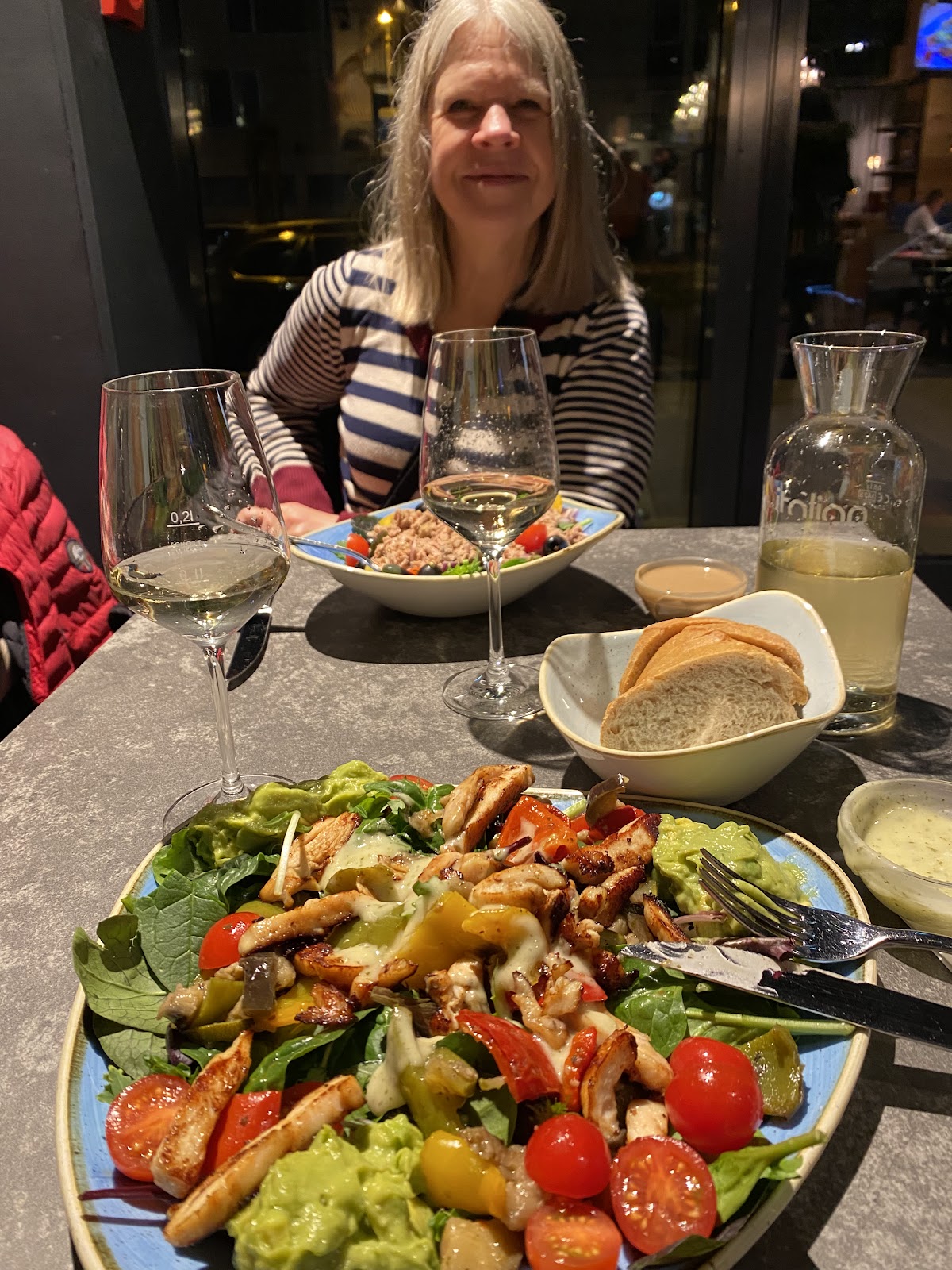
Lunches in Germany presented the typical offerings of soups, salads, sandwiches, or a hot entrée. Americans do not normally think of salads as German food; however, I would encourage travelers to order a salad. I had some incredible salads in Germany. They are abundant and delicious. Teresa is known for ordering salads on our research trips together.


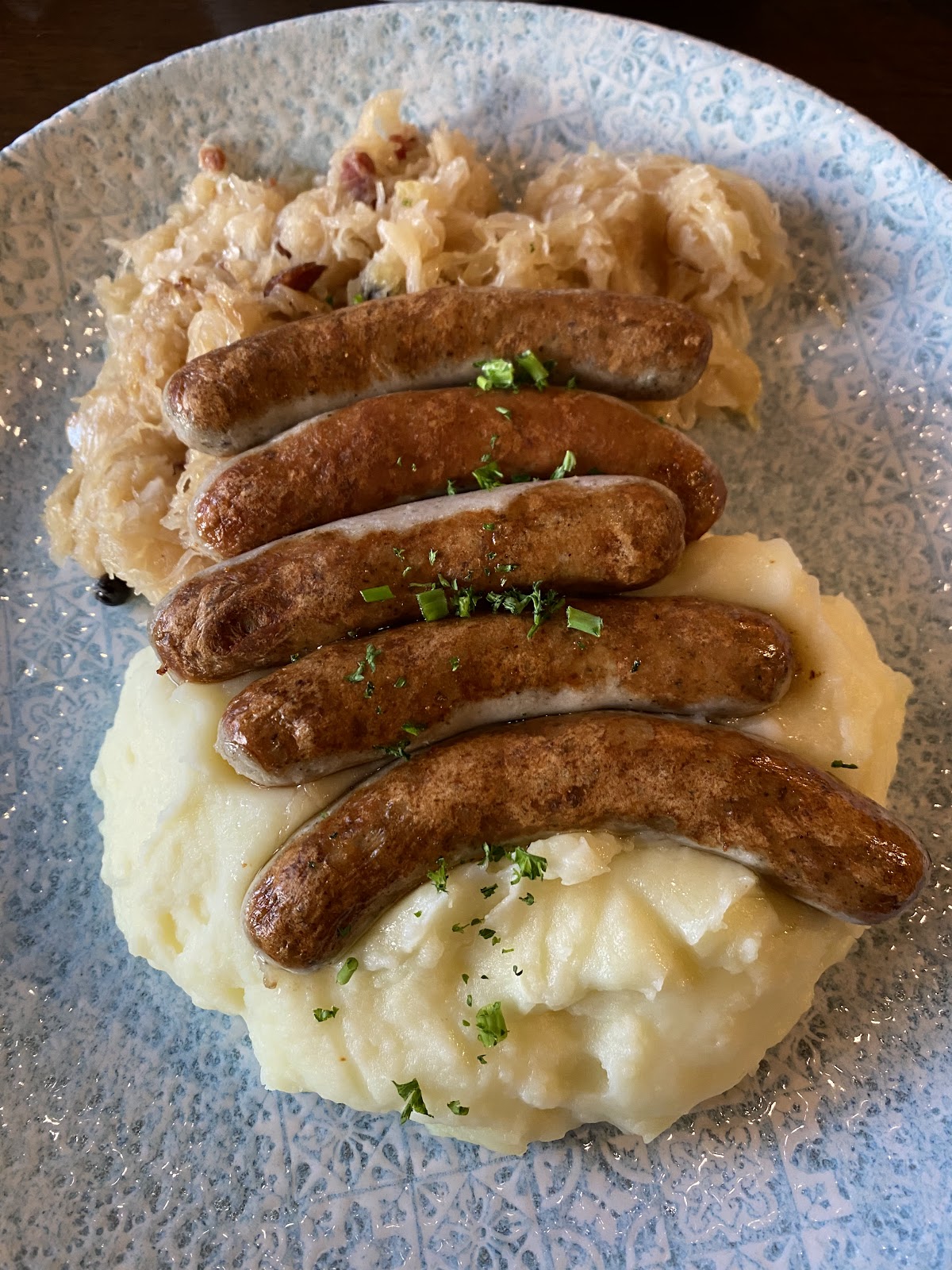
In Germany, their dinner options are what we might expect to order in America. I was not expecting the wide variety of restaurants because I had my heart set on good typical German fare of wurst and sauerkraut or schnitzel. But you can find Greek, Indian, Italian, and Mexican restaurants and we happily tried them all!


Some other differences to keep in mind when eating out is that you will not receive your bill [rechnung] until you ask for it. Dining out is about good food and socializing, so they do not rush you. Also, tipping is different. There is not the traditional tipping structure in Germany that there is in America. You can certainly leave a tip, and we did, but it is not customary or expected like it is in America. 


Luckily, in between researching at repositories and dining out, we did a lot of walking, which helped to ensure I did not gain weight after enjoying all the wonderful meals on the trip! Guten Appetit!


Thursday, March 13, 2025

 From German Girls Genealogy (Teresa Steinkamp McMillin & Debra A. Hoffman): 

In a prior post, I described the Catholic graveyard in Schweighausen. It is connected to St. Romanus Church. In 1132, a chapel was consecrated in Schweighausen to honor St. Romanus. The current building was erected in 1777. After a fire in 2006, it was renovated into the church we see today. 


We were able to go inside to look around. The baptismal font dates from 1275. Many of my ancestors were baptized at that font. It’s crazy to think it has seen generations of people whose names I will never know because the earliest baptism dates from 1646. The organ at this church, not nearly as old, was installed in the late 1700s.


It was late January, but the Christmas décor still stood. The nativity scene was a unique assembly of natural materials pulled from the Black Forest, of which Schweighausen is part. It primarily consisted of branches, stones, and moss. Our guide explained that he and two other men spent thirty hours building it. And they do it every year. The stones, many containing fossils, are reused, but the other elements are gathered fresh each year. The manger would stay intact until early February.


And speaking of fossils. The flooring in the church was made of natural stone pulled from the region. If you look carefully, you will find many examples of fossils quietly witnessing the history that continues to unfold in this church.